Harbour village · North Kefalonia
Fiscardo
Φισκάρδο
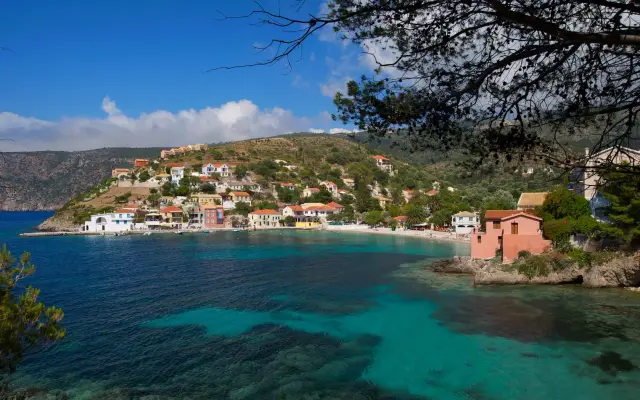
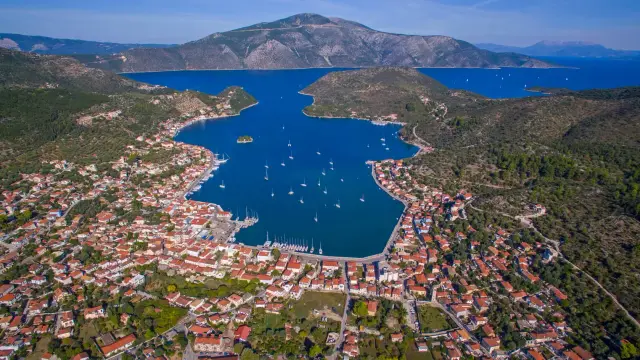
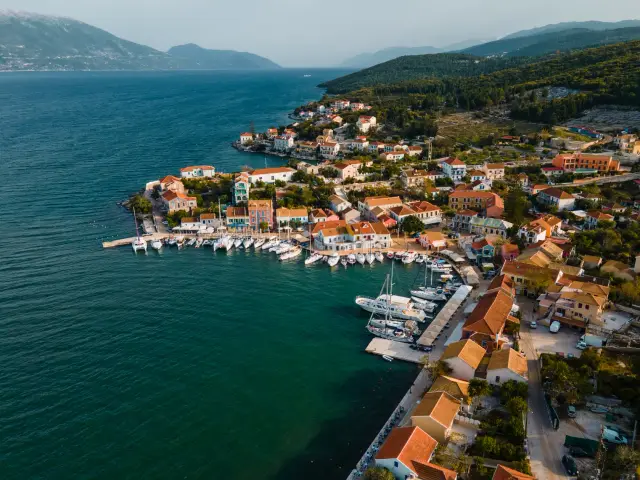
The prettiest harbour on Kefalonia is also one of its oldest. Fiscardo, at the island's northern tip, was spared by the 1953 earthquake, so its pastel Venetian-era houses still line the bay as they have for centuries — with Ithaca and Lefkada just across the water.
At a glance
- Type
- Harbour village
- Area
- Erisos, north Kefalonia
- From the airport
- About 61 km by road (around 1½ hours)
- Good for
- Waterfront walks, history, swimming coves
- Ferries
- Seasonal routes to Lefkada and Ithaca
The story of Fiscardo
Long before it had its current name, the bay was home to a Roman-era town identified with ancient Panormos — "the all-weather harbour", a fitting name for one of the most sheltered anchorages in the Ionian Sea. Inscriptions point to a functioning local government, and archaeologists have traced a small odeon (a roofed theatre), a stepped street, houses and a bath complex around the bay. Part of the old public square now lies under the water near the waterfront.
The town faded in late antiquity, but the headland at the mouth of the bay kept its importance as a landmark for sailors. An early Christian church was built there, probably in the 5th or 6th century, and was later rebuilt with two towers. Its ruins still stand on the headland next to the lighthouses.
The modern name comes from one of the most feared men of the 11th century. Robert Guiscard, the Norman duke who had conquered most of southern Italy, was campaigning against the Byzantine Empire when he fell ill with a fever and died on Kefalonia in July 1085. The harbour took his name — Guiscardo, later Viscardo and finally Fiscardo. His body was taken back to Italy, but the name stayed.
After centuries of near-emptiness, the bay filled again in late Venetian and early British times, when merchants and sea captains built the stone houses and warehouses you see today. Then came August 1953: a series of earthquakes destroyed almost every town and village on Kefalonia. Fiscardo was one of the very few places that survived, which makes it the best place on the island to see what Kefalonia looked like before the quake. The village and the forest around it are protected by Greek law as an area of outstanding natural beauty.
What to see and do
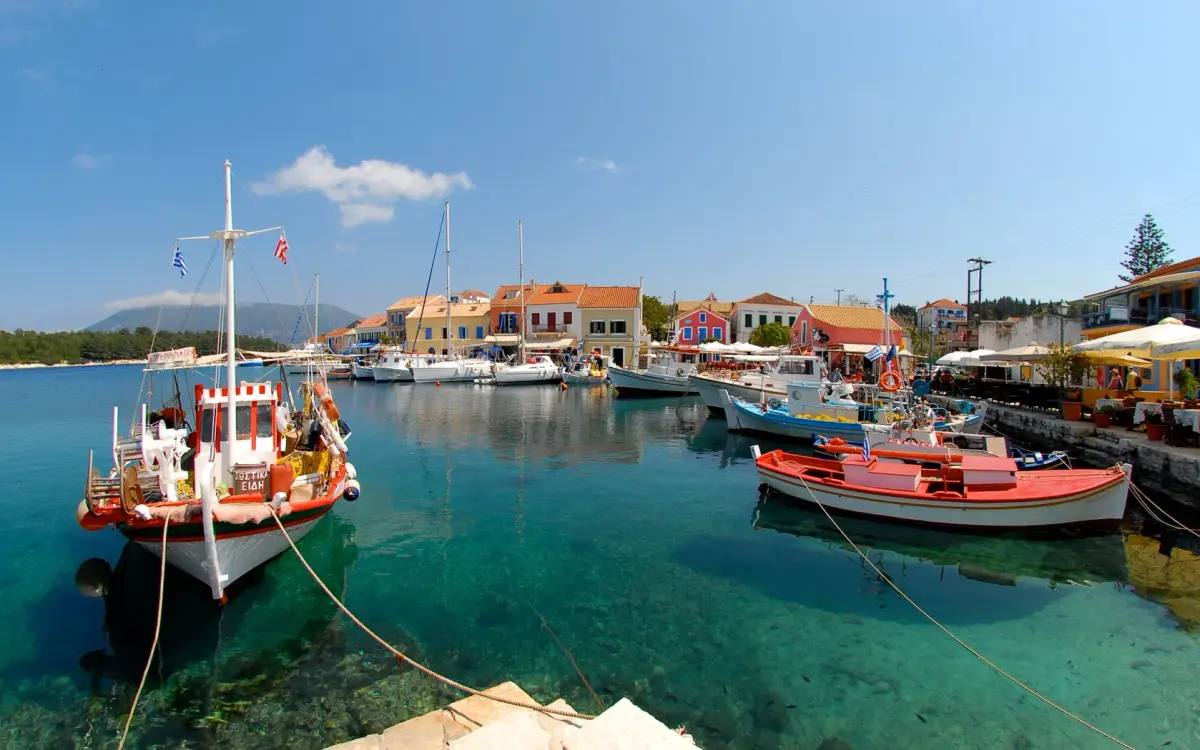
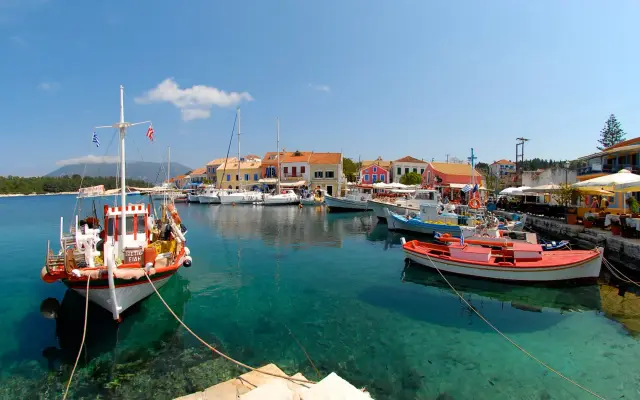
The waterfront. Fiscardo is small and best explored on foot. The harbour is lined with restored captains' houses in ochre, pink and cream, with tavernas and cafés at street level and fishing boats moored next to sailing yachts. Walk around to both ends of the bay: the view back over the village changes completely.
The lighthouses and the old church. A short, easy path (under 1 km) leads from the harbour through pine and cypress to the headland. Here you find two lighthouses side by side — an older Venetian-era tower and a newer one from 1892 — and the ruins of the early Christian church. Ithaca is so close it feels like part of the view; on clear days you can see Lefkada to the north.
The Roman cemetery. Found by accident during public works in 1993 and excavated over the following years, the cemetery held 47 tombs from roughly the 2nd to 4th centuries AD, including stone sarcophagi. Jewellery, glass vessels, lamps and coins were found inside. The site lies a short walk along the coast from the harbour.
The Nautical & Environmental Museum. A small museum about the sea around Fiscardo, with skeletons of marine mammals — including a whale that washed up at nearby Emblisi in 1995 — and old photographs of the area.
Swim nearby. There is no sandy beach in the village itself, but there are clear-water pebble coves within walking distance. Foki is a sheltered, tree-shaded bay south of the village with a small sea cave at its edge; Emblisi, north-west of the harbour, has very clear water that is good for snorkelling. Neither has rows of sunbeds — bring your own shade and water shoes.
When to visit
Fiscardo is busiest in July and August, when the harbour fills with yachts and some have to anchor out in the bay overnight. Late May, June and September are calmer and still warm enough for swimming. The village is at its most relaxed in the early morning and in the evening, after the day visitors have left.
Getting there
- By road: Fiscardo is at the end of the main road north, about 61 km (around 1½ hours) from the airport; the last stretch is winding. The village centre is car-free, so park on the edge and walk in.
- By ferry: In summer, ferries connect Fiscardo with Lefkada (Vasiliki, about 1 hour) and Ithaca (about 45 minutes). In winter there are fewer sailings — check the current timetable before you plan.
- By boat or on an excursion: Fiscardo is a classic stop on island tours by road and on day cruises along the east coast.
Good to know
- Wear proper shoes for the lighthouse path and the walks to Foki and Emblisi.
- Prices in Fiscardo are higher than elsewhere on the island — it is a favourite stop for yachts.
- The poet Nikos Kavvadias, known for his poems about the sea, spent time in the village.
Questions about Fiscardo
Why is Fiscardo different from other villages on Kefalonia?
It was spared the worst of the 1953 earthquake, so its older houses survived while most of the island had to be rebuilt. That makes it the best place to see Kefalonia's pre-1953 architecture.
Is Fiscardo named after Robert Guiscard?
Yes. The Norman leader died on Kefalonia in 1085 and the harbour was named after him: Guiscardo, then Viscardo, then Fiscardo.
Is there a beach in Fiscardo?
Not in the harbour itself, but Foki and Emblisi are pebble coves within walking distance.
Can I visit Fiscardo on a day trip?
Yes — by car, by ferry from Lefkada or Ithaca, or on an organised bus or boat excursion from other parts of Kefalonia.
Excursions with KCG Tours
Visit Fiscardo with us
 Bus Tours
Fiscardo Island Tour
Stop: Fiscardo Village
8 HoursFrom €37.50/ person Bus Tours
Sunday Island Tour
Stop: Fiscardo Village
8 HoursFrom €37.50/ person
 DeutschDeutschsprachige Touren
Kefalonia Entdecken
Stop: Fiscardo Dorf
8 StundenFrom €57.50/ person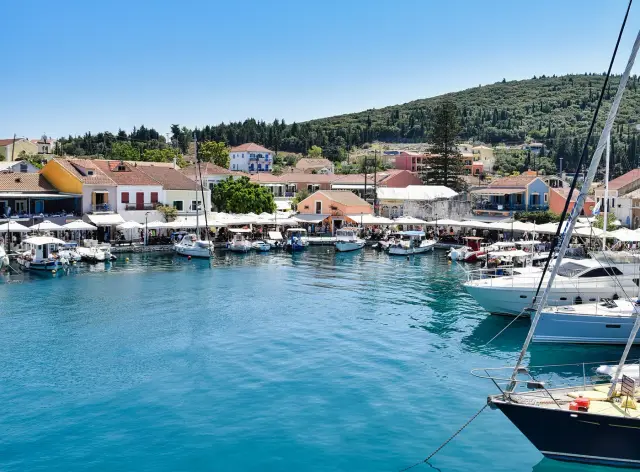 Cruises from Skala
Fiscardo Cruise from Skala
Stop: Fiscardo Village
Full DayFrom €55/ person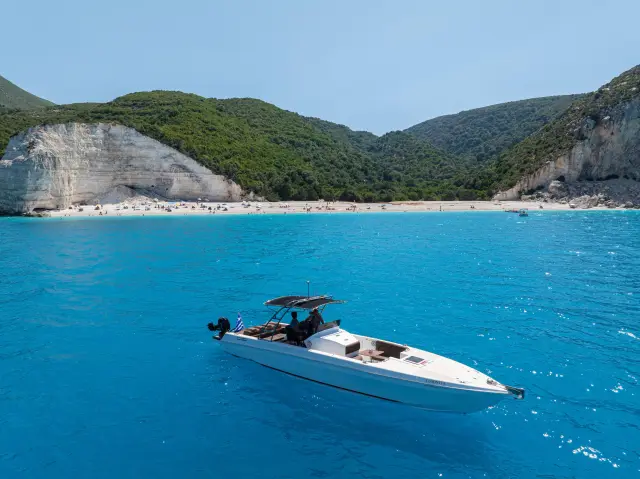 Cruises from Sami
Full Round of Ithaca Cruise
Stop: Fiskardo, Kefalonia
8 HoursFrom €720/ boat (up to 9 guests)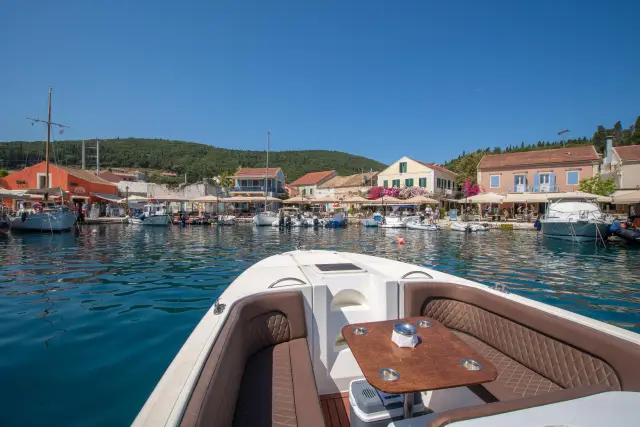 Cruises from Sami
Full Round of Kefalonia Cruise
Stop: Fiscardo – Coffee & Walk
9 HoursFrom €1200/ boat (up to 9 guests) Shore Excursions
Assos & Fiscardo
Stop: Fiscardo
5–6 HoursFrom €250/ groupBooked on request
Prices are "from" prices; live availability and final prices are on each tour page. See all our tours